Erika is killed at Hartheim
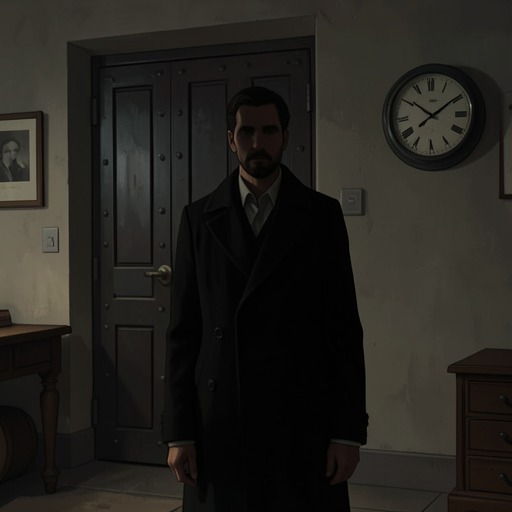
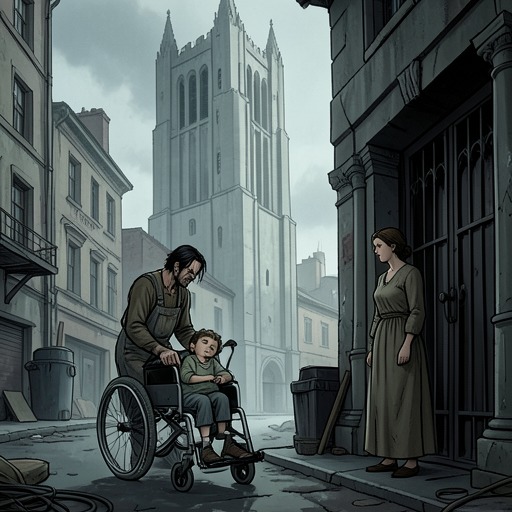
The Glass RoomErika is killed at Hartheim after a childhood illness progressively deprives her of abilities she had once possessed. The death is disclosed not as an impersonal historical fact but as a father’s belated confession to Hana Hanáková: a secret that links his family’s grief to his belief in science, his sense of helplessness, and the unresolved question of what could count as mercy.
Illness and loss
Erika is the daughter whose existence her father first conceals, telling Hana that there had been no child. He then corrects the lie: he and Hedda had a daughter and named her Erika. He remembers her as a beautiful, much-loved baby, and recalls Hedda finding a fulfilment beyond music in caring for her. Their daughter’s arrival had seemed to bring the couple a new possibility, born of a love that others regarded as crossing forbidden boundaries.
For Erika’s first six months, her development seemed reassuring. Her father compares the precision of a piano chord to the apparent order of her early life: she grew, smiled, laughed, recognized her parents, and reached toward them from her cot. The change came gradually. She stopped smiling, then ceased to look at them, and lost the ability to grasp her rattles and toys. The image of a piano falling out of tune gives the decline a shape he can articulate, but it does not make the loss intelligible or reversible.
Her father names the condition as infantile amaurotic congenital idiocy, explaining that blindness was one of its symptoms. He describes its eventual course as a loss of the ability to swallow, with starvation or pneumonia as possible causes of death. But he insists that this was not Erika’s end. That distinction opens the way to the story of Hartheim: she died there before reaching the final stage he has described.
The journey to Hartheim
When Erika was four, her parents drove from Munich to a castle in a village in Upper Austria. The journey took place in winter, and the roads were difficult. Snow covered the surroundings when they arrived. They parked outside the main gate and carried Erika to the entrance, where an orderly appeared soon after they rang the bell. Her father assumes the staff had been expecting them.
He calls the place a kind of clinic. The process was efficient: the parents signed a few forms, though most arrangements had already been made, and their identities were confirmed. They were then shown to a waiting room, where they could pray or do as they wished. By then, he says, there was little purpose in trying to say goodbye; in his understanding, they had already lost their child months earlier, as Erika’s deterioration had taken away the baby they had known. After five minutes, a nurse came and took her away.
The contrast between the family’s personal catastrophe and the institution’s orderly procedure is central to the account. A short journey, formalities, and a waiting period carry the parents from the care of their child to her death. The narration does not make the procedure an answer to their anguish: its efficiency only marks how completely the decisive act has passed out of their hands.
Death and its justification
Erika is killed by injection at Hartheim. Her father says that morphia and scopolamine were used to put her out of her misery, and adds that he thinks it was for the best. His account establishes the outcome and the reason he gives for it, but it does not present that judgment as an easy or settled conclusion. Hana responds that she does not know how to take what he has told her; he agrees that there are no easy answers and recalls that Hedda found none either.
The consequences reach beyond Erika’s death. A few days later, Hedda returned early from the conservatory, ran a bath, and ended her life with one of her husband’s razors. The narrative places this loss immediately after the account of Hartheim, linking the daughter’s killing to the mother’s inability to continue without suggesting that one event wholly explains another. Erika’s death thus stands within a family’s sequence of grief: illness, a decision made under unbearable circumstances, and the further loss of Hedda.
Confession and meaning
The event reaches the reader through Erika’s father speaking to Hana in the Glass Room. Before he tells her, he has concealed the child’s existence; now he discloses both Erika’s illness and the circumstances of her death. The telling is explicitly difficult: he does not understand why he is revealing what he has never told anyone else, or why his defences have given way. His confession makes Hana a witness to a history he has kept private, while exposing how little the act of telling can resolve.
His appeal to science remains caught between confidence and failure. He thinks science holds the key to everything and will ultimately solve every problem, yet the story he confesses concerns an illness he could not cure and a death whose moral meaning he cannot make secure. His claim that the killing was for the best coexists with his grief and with his admission that there are no easy answers. The event’s significance lies in that unresolved tension: scientific language gives him a name for the condition and a rationale for the outcome, but it cannot restore Erika or settle what her parents were forced to choose.